Booleans
A boolean has only two possible values: True or False. There is no “sort of”. Learning to phrase a question so it has a clean yes/no answer is half the skill.

This is where a program stops following one path and starts making choices.
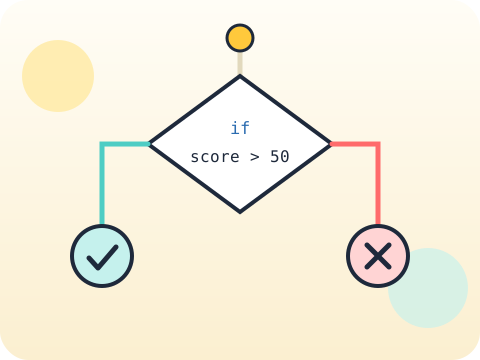
Conditions let a program ask a yes-or-no question and act on the answer. Every login screen, every game-over message and every “are you sure?” box in existence is built from this one idea, repeated at scale.
Decision logic is the bridge between a script that runs the same way every time and software that reacts to the world.
Three core ideas, each taught with worked examples and then practised until it feels obvious.
A boolean has only two possible values: True or False. There is no “sort of”. Learning to phrase a question so it has a clean yes/no answer is half the skill.
if runs a block when the answer is True; else covers everything left over. elif lets you stack extra questions in between, checked in order from top to bottom.
Comparison operators (>, <, ==, !=, >=, <=) are how you ask the question. Choosing > instead of >= is a one-character difference that changes who passes and who fails.
Python is one of very few popular languages where indentation is not a style choice — the spaces at the start of a line actually decide what belongs inside the if.
“More ifs means smarter code.” Often the opposite. Two clear conditions usually beat six tangled ones, and are far easier to fix later.
Sessions 17–24 of the 72-session year, at two one-hour sessions per week.
Where this module fits, what you will build, and a hands-on starter that gets everyone curious about booleans.
Guided teaching on booleans, worked through together with the teacher.
Independent practice, small challenges and one deliberate mistake to diagnose.
Guided teaching on if and else, building directly on the previous two sessions.
Applied tasks that combine booleans and if and else in one piece of work.
Comparison operators introduced and practised, completing the toolkit needed for the project.
Guided build session for the module project: Choose-your-path story.
Finish, test against the checklist, present the work and explain the decisions behind it.
Every module ends with something the student built themselves and can demonstrate. This is the piece that goes into their portfolio and gets explained out loud at the end of session 24.
Write a program that reads a test score and prints a grade. Then hand it to a sibling and challenge them to find a score that breaks it.
Students finishing Module 3 can:
The vocabulary introduced here, in plain language:
6 quick questions drawn from this module — vocabulary, the project you build, and a myth-or-fact round. Every wrong answer explains itself, so a mistake still teaches you something.
Tell us your child’s class and what they enjoy. We will suggest the closest program fit—no pressure and no upfront payment.