
Coding classes for kids in Hyderabad — real Python, one confident step at a time.
Five progressive annual coding curricula—from a first Python program in Class 6 to web, data and AI-enabled projects in Class 10. Taught in person, in batches of eight.
Quick answer
Brolly Juniors runs coding classes for kids in Hyderabad from Class 6 to Class 10. Each class has its own 72-session plan spanning nine modules plus a capstone project. Topics include logic, algorithms, Python syntax, games, data work and testing—taught through explanation, guided coding, debugging and projects, in batches capped at eight children.
What are Python classes for kids?
Python is a programming language — a way of writing instructions that a computer follows. Python classes teach children to write those instructions themselves, starting from a single line and building up to small working programs.
Why Python suits beginners
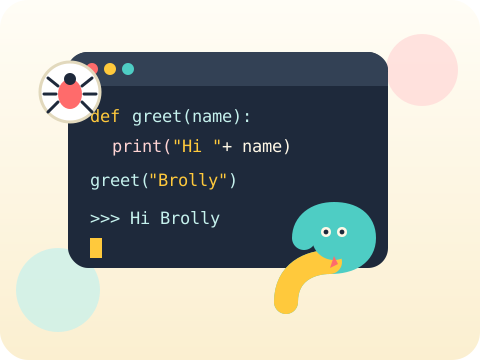
Python reads a lot like plain English. To show a message on screen a child writes print("Hello") — and that is genuinely all it takes. There is no complicated setup to memorise before the first result appears, which matters enormously when a ten-year-old is deciding whether coding is for them.
Because the language stays out of the way, children spend their attention on the interesting part: working out what the computer should do, and in what order.
How a child actually learns it
Learning to code is a loop, not a lecture. Children move through it many times in a single session, and the code will not always work the first time. That is the point — finding out why it did not work is where most of the thinking happens.
- Idea →
- Write code →
- Run it →
- See the result →
- Improve it
The shape of the year
- Simple instructions first. Printing messages, storing values, doing arithmetic. Small wins, quickly.
- Then decisions and repetition. Conditions and loops let a program behave differently depending on what happens.
- Then whole programs. Functions, lists and structure let a child build a quiz, a game or a small tool.
Nine modules across 36 weeks, then a capstone the child demonstrates and explains.
Why should kids learn Python?
Not because every child will become a software engineer. Because the habits coding builds — breaking a problem down, testing an idea, fixing what is broken — are useful whatever they go on to do.
Logical thinking
A program only works if the steps are in the right order. Children learn to break a task into smaller steps and sequence them deliberately.
Problem solving
There is rarely one correct program. Children try an approach, see where it falls short and reach for another.
Creativity
Code is a making material. Children use it to build small games, quizzes and programs that are theirs.
Computational thinking
Giving precise instructions to something that follows them literally is a genuinely different way of thinking — and a teachable one.
Confidence
Finishing something that runs, and being able to explain how it works, changes how a child sees technology: as something they shape, not just consume.
Future digital skills
Python is widely used across software, data work, automation and AI. Learning it early gives children a familiar starting point later.
An honest note: these are the kinds of benefits that come from sustained, guided practice — not guaranteed outcomes. We do not promise marks, careers or salaries, and you should be wary of any children’s programme that does.
Typed code, not drag-and-drop blocks
Students write real Python from the first session. Each of the nine modules ends in a working artefact—a quiz, a game, a data tool, an application—and the year finishes with a capstone the student demonstrates and explains.
- Live coding, then guided practice
- Reading error messages and debugging
- Mini-project at the end of every module
- Annual capstone with documentation
A distinct annual curriculum for every class
Python is organised by school class rather than by age, because that is how children’s reading, maths and school workload actually line up.
Python Course · Class 6
A first Python program, loops, functions and a young coder capstone.
🐍Python Course · Class 7
Stronger logic, data structures, games and real applications.
🐍Python Course · Class 8
Stronger logic, data structures, games and real applications.
🐍Python Course · Class 9
Stronger logic, data structures, games and real applications.
🐍Python Course · Class 10
Web, data and AI-enabled projects with a deployed capstone.
Younger than Class 6? The Python programme starts there. Younger children are better served by coding for kids and digital literacy, which build the groundwork Python later sits on. And a Class 8 child with no coding background does not have to start in the Class 6 plan — the first module establishes the foundation, and the trial class is where that judgement gets made.
Python learning levels for kids
Within a year, the nine modules move through four broad stages before the capstone. The pace and the projects differ by class; the shape of the journey does not.
Python basics
Goal: Get code running and get a result on screen.
Concepts: What coding is, the Python editor, print(), comments, simple instructions.
Typical activity: A program that introduces the child by name and does a little arithmetic.
Programming fundamentals
Goal: Store information and make the program respond to it.
Concepts: Variables, numbers and strings, basic data types, operators, if and else.
Typical activity: A program that reacts differently depending on what is typed in.
Coding skills
Goal: Stop repeating yourself and start structuring code.
Concepts: for and while loops, functions and parameters, lists and collections.
Typical activity: A number-guessing game that keeps asking until the answer is right.
Project building
Goal: Combine everything into something that works end to end.
Concepts: Planning a program, combining concepts, testing, debugging.
Typical activity: A quiz game or small tool built across more than one session.
Annual capstone
Goal: Finish something worth showing, and be able to explain it.
Concepts: Every year ends with a class-appropriate capstone the student demonstrates and talks through.
Typical activity: In Class 10 that capstone is deployed.
Python course curriculum for kids
The blocks below describe the ground a Python course for children covers. Depth, pace and project choice differ by class, so read this as a map of the territory rather than a session-by-session syllabus.
Python basics
- Introduction to Python
- Syntax and indentation
- print() and output
- Comments
- Running a first program
Variables & data
- Variables and naming
- Numbers and strings
- Basic data types
- Input from the user
- Operators and arithmetic
Conditions
- if, else, elif
- Comparisons
- Simple decision-making
- Combining conditions
Loops
- Repeating instructions
- for loops and range()
- while loops
- Stopping a loop safely
Functions
- Reusable blocks of code
- Parameters and arguments
- Returning a value
- Why functions keep code tidy
Lists & collections
- Making a list
- Accessing and changing items
- Looping through a list
- Basic list operations
Problem solving
- Breaking a problem into steps
- Writing a solution
- Testing what you wrote
- Reading error messages
- Fixing errors independently
Python projects
- Mini games
- Calculators
- Quiz programs
- Number games
- Small creative programs
Beyond the basics
- Data work in later classes
- Larger applications
- Web and AI-enabled projects in Class 10
- A deployed capstone
The exact curriculum varies by class, level and the child’s starting point. There is a distinct annual plan for each of Classes 6 to 10 — ask us for the plan for your child’s year.
What happens in a Python class?
Sessions run for one hour, twice a week. Here is the shape a typical one takes, so you know what your child is actually doing with that hour.
Warm-up
A short recap or a quick logic puzzle to get thinking started before the laptops open.
Concept introduction
One new idea, explained simply — what it does, and why anyone would want it.
Live coding
The educator writes the code on screen, thinking out loud, mistakes included.
Guided practice
Children type their own version. With eight to a batch, the educator can reach every child.
Mini challenge
A small twist on the idea, solved without step-by-step instructions.
Project activity
Work continues on the module’s project, so the pieces add up to something.
Recap
What was learned, what to practise, what comes next.
Python projects kids can build
These are the kinds of programs that come out of the early and middle modules. They are small on purpose — small enough to finish, and finishing matters.
Simple calculator
Takes two numbers and an operation, returns an answer. Practises input, variables and arithmetic.
Quiz game
Asks questions, checks answers, keeps score. Practises conditions, lists and counters.
Number guessing game
The computer picks a number and gives hints. Practises loops, conditions and randomness.
Rock paper scissors
Play against the computer. Practises user input, comparisons and repeated rounds.
To-do list
Add, view and remove items. Practises lists and structuring a program with functions.
Simple text game
A choose-your-path story. Combines almost everything learned so far into one program.
Later years go further. Class 10 works on web, data and AI-enabled projects with a deployed capstone. We will not tell you a Class 6 child will build advanced AI applications, because they will not — and a page that promises it is not being straight with you.
Fun Python activities for kids
Practice does not have to look like homework. These activities are woven through the modules.
- Coding challenges
- Debugging games
- Logic puzzles
- Mini coding quizzes
- Pattern challenges
- Programming games
- Build-and-test
- Project challenges
Coding for children, not medical coding
Worth saying plainly, because searching for coding classes in Hyderabad returns a great many medical billing and coding institutes: this is computer programming for school-age children. Python, typed by the child, on a real keyboard.
Nothing here is for adults changing careers, and nothing here is healthcare administration. If you are looking for medical coding certification, this is not it — and we would rather you found that out in ten seconds than after a phone call.
A room in Hyderabad, not a template page
Several of the largest names ranking for this search are national platforms with a page for every city and a presence in none of them. There is no address on those pages, no local teacher, and no photograph of a room your child could actually sit in.
- In-person classes, eight children to a batch
- The same educator each week, who knows your child's name
- Batch times built around Hyderabad school and traffic patterns
- A curriculum that continues next year rather than resetting
Why parents choose Brolly Juniors for Python
Four things that decide whether a beginner is still coding six months later.
Batches capped at eight
Small enough that nobody quietly falls behind while the confident ones race ahead. It is the single biggest factor in whether a beginner keeps going.
Typed code, not blocks
Children write real Python from the first session. Block-based tools have their place earlier on, but they do not build the typing, syntax and debugging habits actual programming needs.
A curriculum that continues
Classes 6 to 10 each have a distinct annual plan. A child who stays does not sit through the same year again — they move forward.
Every module ships something
Nine modules, nine working artefacts, then a capstone. Progress is visible to you because there is something to look at.
Learning modes, timings and fees
The programme is built around an in-person room, and runs as two one-hour sessions a week across 36 instructional weeks.
Learning modes
In person, or in your school
- Classes at Nizampet X Roads, batches capped at eight
- The same educator every week
- Schools can run the same 72-session plan through their own lab — see the school curriculum
Class timings
Monday – Saturday, 10:00 am – 7:00 pm
- Two one-hour sessions a week
- Weekday after-school and weekend batches
- Slots change through the year, so we confirm what is open
Python fees
Nothing before the trial
- Depends on your child’s class and annual plan
- Where they start, if they have coded before
- Send us the class and we will send the current figure
Asking about online classes? Online delivery is not something we advertise, because the programme is built around an in-person room. If online is your only workable option, tell us and we will say honestly whether we can serve you well.
Let your child experience a Python class
Not sure if Python is right for your child? Start with a trial session and understand the teaching approach before enrolling. Tell us your child’s class and what they enjoy, and we will suggest the closest programme fit — no pressure, and no upfront payment.
- Your child sits in a real session, at a real keyboard
- We see where they are starting from
- You see how the educator teaches
- We recommend the class plan and batch that fits
- You decide afterwards, not before
Metro Pillar No. A689, Dr Atmaram Estates, 3rd Floor, Nizampet X Roads, Nizampet, Hyderabad, Telangana, 500072
Request your free trial
Supporting your child’s Python progress
Coding progress is easy to see if you know where to look, because every module produces something that runs. You do not need to understand Python yourself to follow it.
Topics covered
Ask which module they are in and what it is about. There are nine across the year, so it gives you a clear sense of pace.
Activities completed
Ask what they typed today and whether it worked first time. The answer is usually a story.
Projects created
Each module ends in a working program. Ask to be shown it running — that is the real progress report.
Areas needing practice
If the same kind of error keeps coming up, that is worth mentioning to the educator.
Learning milestones
First working loop, first function, first finished project, then the annual capstone.
Just ask us
With eight children to a batch, the educator genuinely knows how your child is doing.
How parents can help kids learn Python
You do not need to know how to code. The most useful things you can do are all things a non-programmer can do well.
Do this
- Ask them to explain their code. “What does this line do?” is a genuinely powerful question.
- Let them make mistakes. Errors are the curriculum, not an interruption to it.
- Encourage short, regular practice. Twenty minutes a few times a week beats a three-hour weekend session.
- Celebrate the effort, not just the working program. Debugging for forty minutes is the skill.
- Give them a quiet spot and a real keyboard.
- Encourage small projects of their own. A silly game they invented will teach more than a perfect exercise.
Try to avoid this
- Fixing every error for them. Even if you can see it. Especially if you can see it.
- Comparing them to another child. Beginners progress at wildly different rates and it evens out.
- Treating a bug as failure. Professional programmers spend much of their day on exactly this.
- Expecting a visible result every single week. Some modules are foundations.
- Turning practice into a punishment. The fastest way to end a child’s interest in coding.
More reading: the parent guides in Resources cover when to move from Scratch to Python, project ideas by class, and whether to start with AI or coding.
Python classes for kids in Hyderabad
Parents looking for Python classes for kids in Hyderabad can choose a programme by their child’s class, coding experience, learning goals and preferred batch. The centre is at Nizampet X Roads, and families travel to it from across the north-west and west of the city.
Batch times are set with school hours and Hyderabad traffic in mind. There is one centre, not a branch in each neighbourhood.
Areas we serve
- Kids classes in Nizampet
- Kids classes in Kukatpally
- Miyapur
- Kids classes in Kondapur
- Kids classes in Madhapur
- Kids classes in Gachibowli
- Hitech City
- Manikonda
- Nallagandla
Where we are
Metro Pillar No. A689, Dr Atmaram Estates, 3rd Floor, Nizampet X Roads, Nizampet, Hyderabad, Telangana, 500072
Beside Sri Bhramaramba Theatre, near JNTU Metro Station.
Explore more kids learning programs
Children often pair Python with one programme that works a different kind of thinking.
Coding for kids
Blocks to typed code, for children who are not ready to start with Python.
🤖AI for kids
AI literacy for Classes 6–10, with class-wise annual curricula.
🦾Robotics
Building and programming things that move.
🖥️Digital literacy
Files, typing, searching and staying safe online — the groundwork Python sits on.
🧠Brain games
Reasoning and memory work away from the screen.
♟️Chess
Planning, patience and thinking a few moves ahead.
Understand
Clear explanation
Practise
Guided activities
Create
Visible outcomes
What families and schools ask
Is this Python curriculum suitable for a Class 6 beginner?
How many Python sessions are included?
Will students build real projects?
Does my child need a laptop?
What are Python classes for kids?
What is the best age to start learning Python?
Is Python suitable for beginners?
What will kids learn in Python classes?
Are Python classes available online?
Are classroom Python classes available in Hyderabad?
What is the Python course fee in Hyderabad?
Are weekend Python classes available?
How long does it take to learn Python?
What projects can kids build with Python?
How can I book a free Python trial class?
Python for kids: quick answers
Short, direct answers to the questions parents ask most.
Where can my child learn Python in Hyderabad?
Brolly Juniors runs in-person Python classes for Classes 6 to 10 at Nizampet X Roads, Hyderabad, in batches of eight.
Is Python easy for kids?
Python is one of the friendliest first languages because it reads close to plain English and produces a visible result quickly.
Does my child need coding experience to learn Python?
No. The first module builds the foundation from scratch, and practice is adjusted to what the child already knows.
Your child's free trial is one message away.
Tell us your child’s class and what they enjoy. We will suggest the closest program fit—no pressure and no upfront payment.