Responsibilities
Responsibilities should be single and clear. If describing a class needs the word “and”, it is probably two classes.

Good design is mostly deciding what each part is not responsible for.
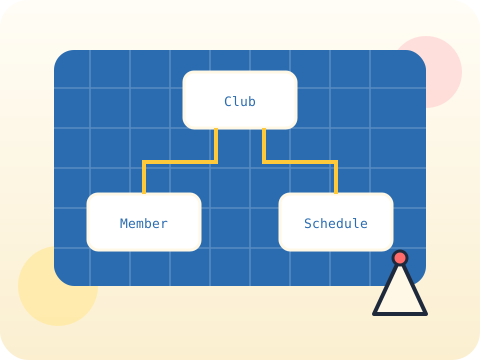
Students design object systems for real domains, assigning responsibilities deliberately, preferring composition to deep hierarchies, and judging their design by how easily it absorbs a new requirement.
Design quality determines whether a codebase can grow. It is the difference between adding a feature in an hour and rewriting for a week.
Three core ideas, each taught with worked examples and then practised until it feels obvious.
Responsibilities should be single and clear. If describing a class needs the word “and”, it is probably two classes.
Composition builds capability by assembly, keeping parts swappable and independently testable.
Design clarity is measured practically: can a new person understand it, and can a new requirement be added without breaking three other things?
The Single Responsibility Principle is the S in SOLID, a set of five design principles that remain the industry’s common vocabulary.
“More classes means better design.” Over-engineering is a real and common failure. The right number of classes is the fewest that keeps things clear.
Sessions 17–24 of the 72-session year, at two one-hour sessions per week.
Where this module fits, what you will build, and a hands-on starter that gets everyone curious about responsibilities.
Guided teaching on responsibilities, worked through together with the teacher.
Independent practice, small challenges and one deliberate mistake to diagnose.
Guided teaching on composition, building directly on the previous two sessions.
Applied tasks that combine responsibilities and composition in one piece of work.
Design clarity introduced and practised, completing the toolkit needed for the project.
Guided build session for the module project: Real-world domain model.
Finish, test against the checklist, present the work and explain the decisions behind it.
Every module ends with something the student built themselves and can demonstrate. This is the piece that goes into their portfolio and gets explained out loud at the end of session 24.
Model a real domain, then add an unplanned requirement. Count how many files you had to open — that number is your design score.
Students finishing Module 3 can:
The vocabulary introduced here, in plain language:
6 quick questions drawn from this module — vocabulary, the project you build, and a myth-or-fact round. Every wrong answer explains itself, so a mistake still teaches you something.
Tell us your child’s class and what they enjoy. We will suggest the closest program fit—no pressure and no upfront payment.