Search and sort
Search and sort algorithms are implemented and timed personally, so the difference stops being theory and becomes a measured graph.

Same answer, wildly different cost. Choosing well is engineering.
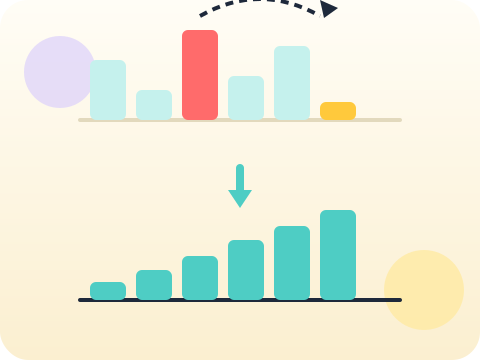
Students implement and measure searching and sorting algorithms, develop Big-O intuition for how cost grows with input size, and learn that every optimisation trades something away.
Complexity reasoning appears in every serious computer science course and in every technical interview a student will ever sit.
Three core ideas, each taught with worked examples and then practised until it feels obvious.
Search and sort algorithms are implemented and timed personally, so the difference stops being theory and becomes a measured graph.
Big-O describes growth, not speed. O(n²) means doubling the input roughly quadruples the work — regardless of how fast your laptop is.
Trade-offs are the real lesson: faster often means more memory, more complexity or more assumptions about the data.
Python’s built-in sort, called Timsort, was invented by Tim Peters in 2002 and is now used inside Java, Android and V8 as well.
“The lowest Big-O wins.” For small inputs, a simple O(n²) sort often beats a complex O(n log n) one. Constants matter in reality.
Sessions 9–16 of the 72-session year, at two one-hour sessions per week.
Where this module fits, what you will build, and a hands-on starter that gets everyone curious about search and sort.
Guided teaching on search and sort, worked through together with the teacher.
Independent practice, small challenges and one deliberate mistake to diagnose.
Guided teaching on big-o intuition, building directly on the previous two sessions.
Applied tasks that combine search and sort and big-o intuition in one piece of work.
Trade-offs introduced and practised, completing the toolkit needed for the project.
Guided build session for the module project: Algorithm comparison lab.
Finish, test against the checklist, present the work and explain the decisions behind it.
Every module ends with something the student built themselves and can demonstrate. This is the piece that goes into their portfolio and gets explained out loud at the end of session 16.
Time bubble sort and Python’s built-in sort on 1,000, 10,000 and 100,000 items. The gap will surprise you.
Students finishing Module 2 can:
The vocabulary introduced here, in plain language:
6 quick questions drawn from this module — vocabulary, the project you build, and a myth-or-fact round. Every wrong answer explains itself, so a mistake still teaches you something.
Tell us your child’s class and what they enjoy. We will suggest the closest program fit—no pressure and no upfront payment.