Role, task and audience
Role, task and audience: tell the AI who to be, what to do and who it is for. Three sentences that transform the quality of the result.

Stop retyping prompts. Start building a library you reuse all year.
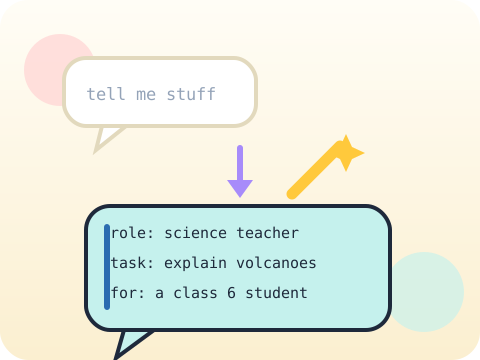
Students learn a repeatable prompt structure — role, task, audience, format — and then iterate deliberately, saving the versions that work into a personal library organised by subject.
A reusable prompt library saves real time every week and turns scattered experimentation into a system.
Three core ideas, each taught with worked examples and then practised until it feels obvious.
Role, task and audience: tell the AI who to be, what to do and who it is for. Three sentences that transform the quality of the result.
Examples and formats matter enormously. Showing one example of the output you want works better than describing it at length.
Prompt iteration means changing one element at a time so you can tell which change actually helped.
Giving a model one or two worked examples is called few-shot prompting, and it often outperforms far longer written instructions.
“Politeness improves answers.” Clarity improves answers. Please and thank you are good manners, not better engineering.
Sessions 9–16 of the 72-session year, at two one-hour sessions per week.
Where this module fits, what you will build, and a hands-on starter that gets everyone curious about role, task and audience.
Guided teaching on role, task and audience, worked through together with the teacher.
Independent practice, small challenges and one deliberate mistake to diagnose.
Guided teaching on examples and formats, building directly on the previous two sessions.
Applied tasks that combine role, task and audience and examples and formats in one piece of work.
Prompt iteration introduced and practised, completing the toolkit needed for the project.
Guided build session for the module project: Reusable prompt library for schoolwork.
Finish, test against the checklist, present the work and explain the decisions behind it.
Every module ends with something the student built themselves and can demonstrate. This is the piece that goes into their portfolio and gets explained out loud at the end of session 16.
Build ten reusable prompts for your three hardest subjects, then use only those for a fortnight and refine the weak ones.
Students finishing Module 2 can:
The vocabulary introduced here, in plain language:
6 quick questions drawn from this module — vocabulary, the project you build, and a myth-or-fact round. Every wrong answer explains itself, so a mistake still teaches you something.
Tell us your child’s class and what they enjoy. We will suggest the closest program fit—no pressure and no upfront payment.