Planning prompts
Planning prompts make the model produce a plan first, which can be reviewed and corrected before any expensive work happens.

Reliable beats clever. Every time, in anything that matters.
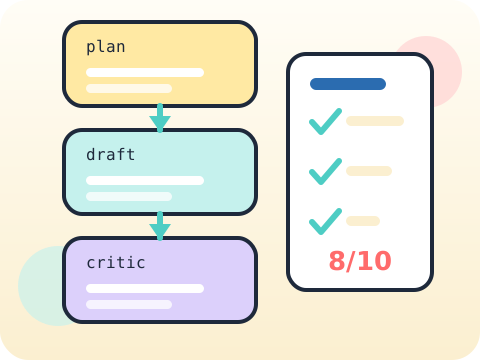
Students construct multi-step workflows with planning prompts, critic prompts that check work against rubrics, and templates that produce consistent quality across different inputs.
Consistency is what makes an AI workflow usable by someone other than its author.
Three core ideas, each taught with worked examples and then practised until it feels obvious.
Planning prompts make the model produce a plan first, which can be reviewed and corrected before any expensive work happens.
Rubrics and critics have one pass generate and another evaluate against fixed criteria, catching weak output before you see it.
Repeatable templates capture the working version so results do not depend on how you happened to phrase it today.
Generator-and-critic setups mirror how editorial teams have always worked. Separating creation from evaluation improves both.
“More steps means better output.” Each step adds cost and failure risk. Add a step only when it demonstrably improves the result.
Sessions 9–16 of the 72-session year, at two one-hour sessions per week.
Where this module fits, what you will build, and a hands-on starter that gets everyone curious about planning prompts.
Guided teaching on planning prompts, worked through together with the teacher.
Independent practice, small challenges and one deliberate mistake to diagnose.
Guided teaching on rubrics and critics, building directly on the previous two sessions.
Applied tasks that combine planning prompts and rubrics and critics in one piece of work.
Repeatable templates introduced and practised, completing the toolkit needed for the project.
Guided build session for the module project: Reliable multi-step prompt workflow.
Finish, test against the checklist, present the work and explain the decisions behind it.
Every module ends with something the student built themselves and can demonstrate. This is the piece that goes into their portfolio and gets explained out loud at the end of session 16.
Add a critic stage to your best workflow and measure whether output scores actually improve. Remove it if they do not.
Students finishing Module 2 can:
The vocabulary introduced here, in plain language:
6 quick questions drawn from this module — vocabulary, the project you build, and a myth-or-fact round. Every wrong answer explains itself, so a mistake still teaches you something.
Tell us your child’s class and what they enjoy. We will suggest the closest program fit—no pressure and no upfront payment.