Agent roles
Agent roles define what each component may do and, importantly, what it may not.

Delegate the work. Never delegate the responsibility.
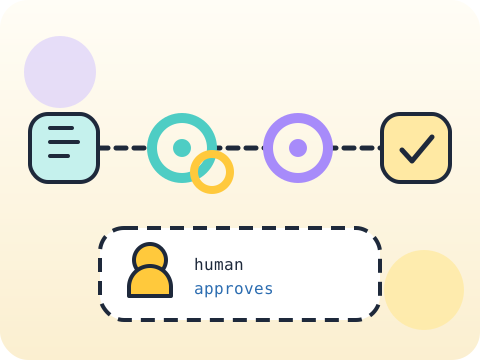
Students design automation that is powerful and controllable — clear agent roles, approval and audit trails, and failure-safe behaviour that degrades gracefully instead of collapsing.
This is the professional standard now emerging around agentic systems, and understanding it early is a genuine advantage.
Three core ideas, each taught with worked examples and then practised until it feels obvious.
Agent roles define what each component may do and, importantly, what it may not.
Approval and audit mean a record of what was done, by which component, and who authorised it.
Failure-safe design ensures that when something breaks the system stops safely rather than continuing incorrectly.
Safety-critical engineering assumes failure will happen and designs for it. Software that assumes success is the outlier, not the norm.
“Logs are only for debugging.” Logs are the accountability record. Without them, nobody can establish what actually happened.
Sessions 49–56 of the 72-session year, at two one-hour sessions per week.
Where this module fits, what you will build, and a hands-on starter that gets everyone curious about agent roles.
Guided teaching on agent roles, worked through together with the teacher.
Independent practice, small challenges and one deliberate mistake to diagnose.
Guided teaching on approval and audit, building directly on the previous two sessions.
Applied tasks that combine agent roles and approval and audit in one piece of work.
Failure-safe design introduced and practised, completing the toolkit needed for the project.
Guided build session for the module project: Responsible automation blueprint.
Finish, test against the checklist, present the work and explain the decisions behind it.
Every module ends with something the student built themselves and can demonstrate. This is the piece that goes into their portfolio and gets explained out loud at the end of session 56.
Take your automation and ask: if this ran wrong for a week unnoticed, what would the damage be? Design the alarm for that.
Students finishing Module 7 can:
The vocabulary introduced here, in plain language:
6 quick questions drawn from this module — vocabulary, the project you build, and a myth-or-fact round. Every wrong answer explains itself, so a mistake still teaches you something.
Tell us your child’s class and what they enjoy. We will suggest the closest program fit—no pressure and no upfront payment.