Workflow logic
Workflow logic sequences steps and decisions, making explicit what happens automatically and what does not.

An agent that acts on your behalf needs to know when to stop and ask.
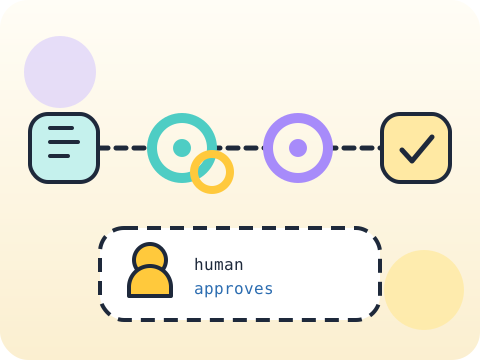
Students map an agentic workflow where AI performs multiple steps, then design the human approval points and error handling that make delegation safe rather than reckless.
Agentic systems are becoming ordinary. Understanding where humans must stay in control is the critical judgement.
Three core ideas, each taught with worked examples and then practised until it feels obvious.
Workflow logic sequences steps and decisions, making explicit what happens automatically and what does not.
Human approval points sit wherever an action is expensive, irreversible or affects other people.
Error handling plans for the step that fails, the ambiguous answer and the loop that never ends.
Aviation solved this decades ago with checklists and mandatory confirmations. Agentic AI design is rediscovering the same principles.
“Full automation is the goal.” The goal is appropriate automation. Some decisions should always require a person.
Sessions 49–56 of the 72-session year, at two one-hour sessions per week.
Where this module fits, what you will build, and a hands-on starter that gets everyone curious about workflow logic.
Guided teaching on workflow logic, worked through together with the teacher.
Independent practice, small challenges and one deliberate mistake to diagnose.
Guided teaching on human approval points, building directly on the previous two sessions.
Applied tasks that combine workflow logic and human approval points in one piece of work.
Error handling introduced and practised, completing the toolkit needed for the project.
Guided build session for the module project: Mapped and demonstrated agentic workflow.
Finish, test against the checklist, present the work and explain the decisions behind it.
Every module ends with something the student built themselves and can demonstrate. This is the piece that goes into their portfolio and gets explained out loud at the end of session 56.
Map your workflow and mark every step where a mistake would be hard to undo. Each mark is an approval gate.
Students finishing Module 7 can:
The vocabulary introduced here, in plain language:
6 quick questions drawn from this module — vocabulary, the project you build, and a myth-or-fact round. Every wrong answer explains itself, so a mistake still teaches you something.
Tell us your child’s class and what they enjoy. We will suggest the closest program fit—no pressure and no upfront payment.