Research questions
Research questions must be specific, answerable and worth asking. Refining the question is most of the work.

Certainty is easy to write. Honest uncertainty is much harder — and much more useful.
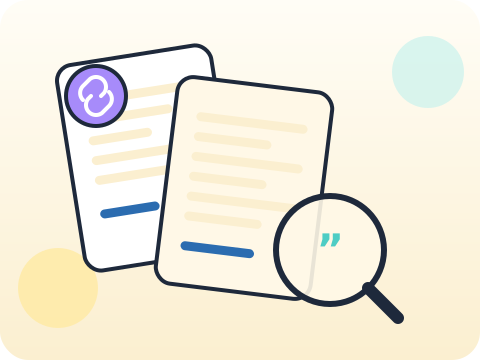
Students conduct academic-standard research: sharp questions, evidence weighed by quality, and writing that states its confidence level honestly rather than flattening everything into assertion.
This is precisely the standard expected at senior school and university, and the students who have practised it arrive ahead.
Three core ideas, each taught with worked examples and then practised until it feels obvious.
Research questions must be specific, answerable and worth asking. Refining the question is most of the work.
Evidence quality varies enormously — sample size, method, funding and replication all matter before the conclusion does.
Citations and uncertainty go together: cite everything, and say plainly where the evidence is thin.
Many published findings across several fields have failed to replicate when retested — the reason single studies should never be treated as settled.
“Saying I am uncertain weakens my work.” Stated uncertainty is a marker of rigour. Unearned certainty is what experts distrust.
Sessions 17–24 of the 72-session year, at two one-hour sessions per week.
Where this module fits, what you will build, and a hands-on starter that gets everyone curious about research questions.
Guided teaching on research questions, worked through together with the teacher.
Independent practice, small challenges and one deliberate mistake to diagnose.
Guided teaching on evidence quality, building directly on the previous two sessions.
Applied tasks that combine research questions and evidence quality in one piece of work.
Citations and uncertainty introduced and practised, completing the toolkit needed for the project.
Guided build session for the module project: Academic-style research explainer.
Finish, test against the checklist, present the work and explain the decisions behind it.
Every module ends with something the student built themselves and can demonstrate. This is the piece that goes into their portfolio and gets explained out loud at the end of session 24.
Grade every source in your bibliography for quality, then check whether your strongest claim rests on your weakest source.
Students finishing Module 3 can:
The vocabulary introduced here, in plain language:
6 quick questions drawn from this module — vocabulary, the project you build, and a myth-or-fact round. Every wrong answer explains itself, so a mistake still teaches you something.
Tell us your child’s class and what they enjoy. We will suggest the closest program fit—no pressure and no upfront payment.