Prompt frameworks
Prompt frameworks give a repeatable skeleton — role, context, task, format, constraints — so nothing important is forgotten.

A prompt you can repeat, test and improve stops being a message and becomes a tool.
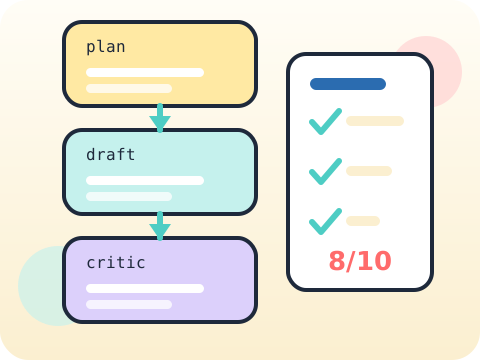
Students build multi-step prompt systems where one output feeds the next, and write rubrics that let them judge output quality consistently instead of by gut feeling.
Systematic prompting produces reliable results. Reliability is what allows a technique to be trusted for schoolwork.
Three core ideas, each taught with worked examples and then practised until it feels obvious.
Prompt frameworks give a repeatable skeleton — role, context, task, format, constraints — so nothing important is forgotten.
Multi-step prompts break big jobs into stages: outline, then draft, then critique, then revise. Each stage is checkable.
Evaluation rubrics define what “good” means before you look at the output, which prevents talking yourself into accepting mediocre work.
Asking a model to critique its own draft against a rubric before revising measurably improves the final result — the same as it does for human writers.
“One perfect prompt solves it.” Complex tasks reliably do better as several small, verified steps.
Sessions 9–16 of the 72-session year, at two one-hour sessions per week.
Where this module fits, what you will build, and a hands-on starter that gets everyone curious about prompt frameworks.
Guided teaching on prompt frameworks, worked through together with the teacher.
Independent practice, small challenges and one deliberate mistake to diagnose.
Guided teaching on multi-step prompts, building directly on the previous two sessions.
Applied tasks that combine prompt frameworks and multi-step prompts in one piece of work.
Evaluation rubrics introduced and practised, completing the toolkit needed for the project.
Guided build session for the module project: Prompt playbook for three school subjects.
Finish, test against the checklist, present the work and explain the decisions behind it.
Every module ends with something the student built themselves and can demonstrate. This is the piece that goes into their portfolio and gets explained out loud at the end of session 16.
Build a three-stage system — outline, draft, critique — for essays, then compare its output against a single-prompt attempt.
Students finishing Module 2 can:
The vocabulary introduced here, in plain language:
6 quick questions drawn from this module — vocabulary, the project you build, and a myth-or-fact round. Every wrong answer explains itself, so a mistake still teaches you something.
Tell us your child’s class and what they enjoy. We will suggest the closest program fit—no pressure and no upfront payment.