Classes
Classes carry responsibilities. A Student class should know about a student — not about printing reports or saving files.

Model the world as things that know something and can do something.
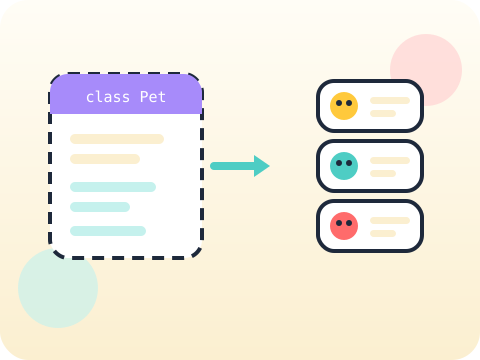
Students design multi-class systems: what each class is responsible for, how classes relate, and when to reuse behaviour through inheritance versus building objects out of other objects.
Modelling a real system in objects is a thinking skill as much as a coding one. It rewards clear analysis of who is responsible for what.
Three core ideas, each taught with worked examples and then practised until it feels obvious.
Classes carry responsibilities. A Student class should know about a student — not about printing reports or saving files.
Inheritance expresses “is a kind of”. A PrefectStudent is a Student with extra powers, inheriting everything and adding a little.
Composition expresses “has a”. A Club has Members and a Schedule. In practice, composition solves more problems more cleanly than inheritance.
Experienced developers have a saying: “favour composition over inheritance.” Deep inheritance trees look elegant and become very hard to change.
“Inheritance is for saving typing.” Inheritance is for expressing a genuine relationship. Using it to share code creates fragile designs.
Sessions 25–32 of the 72-session year, at two one-hour sessions per week.
Where this module fits, what you will build, and a hands-on starter that gets everyone curious about classes.
Guided teaching on classes, worked through together with the teacher.
Independent practice, small challenges and one deliberate mistake to diagnose.
Guided teaching on inheritance intuition, building directly on the previous two sessions.
Applied tasks that combine classes and inheritance intuition in one piece of work.
Composition introduced and practised, completing the toolkit needed for the project.
Guided build session for the module project: School club management model.
Finish, test against the checklist, present the work and explain the decisions behind it.
Every module ends with something the student built themselves and can demonstrate. This is the piece that goes into their portfolio and gets explained out loud at the end of session 32.
Model your school’s club system with at least three classes, then add a brand-new club type and see how much existing code you had to touch.
Students finishing Module 4 can:
The vocabulary introduced here, in plain language:
6 quick questions drawn from this module — vocabulary, the project you build, and a myth-or-fact round. Every wrong answer explains itself, so a mistake still teaches you something.
Tell us your child’s class and what they enjoy. We will suggest the closest program fit—no pressure and no upfront payment.