So what is blending, exactly?
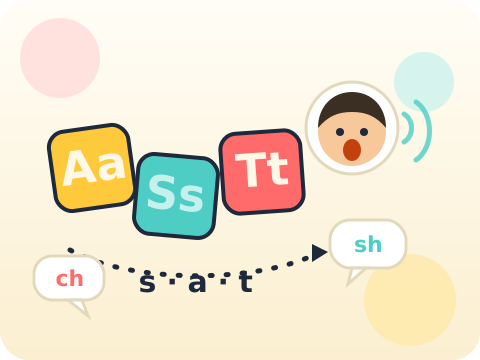
Blending means putting individual sounds together fast enough that they become a word. That is all it is.
But here is the part most people miss. Knowing letter sounds and blending them are two completely different skills. Knowing that "c" says kuh is memory. Turning kuh-a-t into "cat" with no gap in between is something else — often called decoding, and it sits at the heart of phonemic awareness.
Some children pick it up on their own. Plenty of others need it taught properly, as a separate lesson.
Why does this happen to so many children?
Most phonics teaching moves quickly. Maybe too quickly. Children learn their sounds, then get pushed straight into reading whole words, and blending gets assumed somewhere along the way instead of being taught as its own skill.
A child stuck at this stage usually does one of these four things.
- Says each sound separately, with a pause. "kuh… a… tuh" — the sounds are right, but they never join up.
- Guesses from the first letter instead of blending the word out.
- Sounds out a word correctly, then says something completely different.
- Handles short words fine, falls apart the moment the word gets longer.
None of this means your child is not trying or is not bright. Longer words are harder mostly because of working memory: by the time they have worked out the last sound, the first one has already gone.
That is not a permanent weakness. It just means blending needs more direct practice than it is getting right now.
Five steps that actually help
All five work at home, in a few minutes a day, with no materials beyond a pen and paper.
- Start with two sounds, not three. Words like "at", "in", "on". Two sounds are much easier to hold onto than three. Build up to three-sound words like cat, dog and sun once two-sound words feel easy.
- Stretch the word out like a rubber band. Say mmmm…aaaa…t slowly, then say "mat" quickly right after. Hearing both versions back to back is what makes it click for a lot of children.
- Watch out for the extra "uh". The sounds /b/, /d/, /g/, /k/, /p/ and /t/ often pick up a small uh on the end, so "b" becomes buh. That tiny extra sound makes blending much harder. Keeping it short and clean helps more than you would think — this is the same mistake that costs months in early phonics.
- Practise blending out loud before using letters. If a child cannot blend c-a-t spoken aloud into "cat", letters are not the place to start. Oral blending games build the sound skill first, and letters make far more sense afterwards.
- Keep sessions short, but regular. Five minutes a day beats twenty minutes once a week, every single time. Blending works like a muscle — small, repeated practice is what builds it.
If you want the daily five minutes to run itself, our free phonics app is built around exactly this kind of short, repeated blending practice.
Why this one step matters so much
Blending is the exact moment a child stops sounding out letters and starts reading. Everything after this point — reading a full sentence, following a story, reading fluently — is built on top of it.
A child who blends confidently at this stage tends to move through the rest of learning to read much more smoothly. The hardest bit is already done. So it is worth being patient here, even when it feels slow.
When should you actually worry?
Most children get past this within a few weeks of regular practice. Blending usually clicks around age 5, often somewhere mid-year. By age 6, most children can handle simple three-sound words.
If your child is well past that age and still stuck, or has started avoiding reading altogether, it is worth looking at blending on its own. Some children simply need it broken down more slowly and more systematically than a general reading routine allows.
For most children, though, this is a normal bump rather than a lasting problem.
It clicks at a different pace for every child
There is no shame in needing more structured practice to get there. The steps above work at home, but many parents find it easier when a phonics-trained teacher guides the sessions — particularly for the fiddly parts, like the extra uh sound, or the working-memory dip on longer words.
Still not sure whether it is the phonics itself or the blending step that is the sticking point? A free trial class usually makes it obvious within the first fifteen minutes. No pressure and no payment upfront — just a real class, so you can see exactly where the gap is and how it closes.