
Kids activities in Hyderabad that make learning fun
Brolly Juniors helps children build confidence, creativity, problem-solving and future-ready skills through activity-based classes designed around their age and interests — from Abacus and Phonics to AI, Python, communication and the arts.
Age-appropriate · Expert-led · Fun learning · Hyderabad-focused
- Child-friendly learning
- Skill-focused programs
- Flexible batches
- Free trial available
 🔤 Phonics🧮 Abacus🤖 AI & Python
Why choose Brolly Juniors for kids activities in Hyderabad?
Parents come to us for one reason: their child should enjoy the class and still walk away with a real skill. Here is how we try to make that happen.
Age-appropriate learning
Content, pace and activities are matched to what a child of that age can actually enjoy and absorb.
Fun, interactive classes
Children learn by doing — games, challenges and hands-on tasks instead of long lectures.
Skill-based curriculum
Every program works towards a defined skill, so progress is visible rather than vague.
Experienced educators
Sessions are led by teachers who work with children every week and know how to keep them engaged.
Practical learning activities
Projects, puzzles and challenges give children something to build, solve or perform.
Small-batch attention
Regular centre batches are capped at eight children, so every learner is seen, heard and corrected.
Flexible learning options
Weekday, weekend, classroom and online formats that fit around school and family routines.
Parent-friendly communication
You hear how your child is doing, what improved and what to practise next.
Confidence and creativity
Children present, perform and share their work, which makes speaking up feel ordinary.
Future-ready skills
Coding, robotics and AI awareness introduced in a way that suits a child’s level.
Regular progress guidance
Educators share observations and next steps, so practice at home stays useful.
Safe, positive environment
Classes are structured, supervised and encouraging — mistakes are part of learning.
Kids classes & activities available at Brolly Juniors
Six learning areas, one place. Children can start with one program and add another as their interests grow.
AI & Future Technology
Understand the tools that will shape the work your child grows into.
Maths & Brain Skills
Number confidence, focus and the habit of thinking a problem through.
Language & Communication
Reading, speaking and being understood — in more than one language.
Creative & Performing Arts
Making things, performing them, and getting better at both.
Sports & Fitness
Movement, coordination and the habit of being active.
Life Skills
The habits that decide how far everything else goes.
Future-ready skills, all under one roof
Choose an annual AI or Python pathway for Classes 6–10, or confidence-building foundation programs for younger learners.
Artificial Intelligence
A separate 72-session curriculum for every class. Practical AI literacy, creativity, research and responsible use.
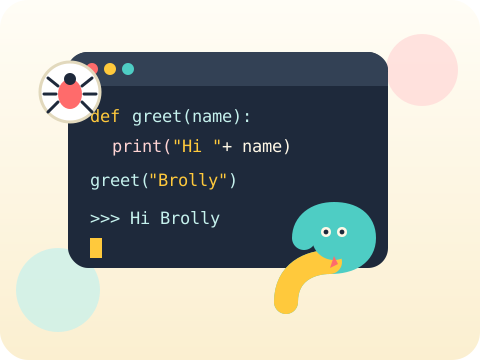
Python & Coding
Real typed Python, class by class—from a first program to games, data, web applications and AI-enabled projects.
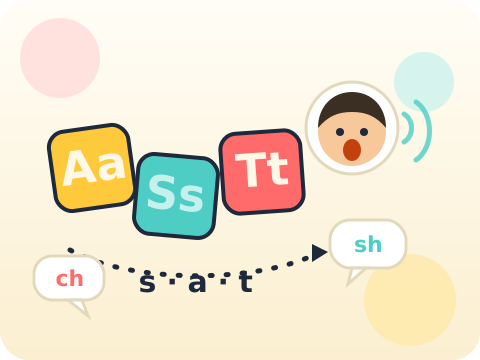
Phonics & Early Reading
A six-level synthetic phonics pathway that takes young learners from single sounds to blending, tricky words and fluent reading.
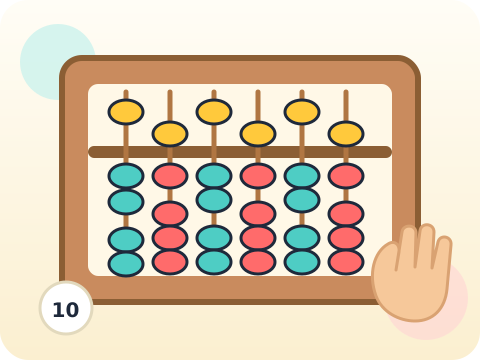
Abacus Mastery
A 10-level Soroban pathway that strengthens focus, working memory, mental visualisation and number confidence.
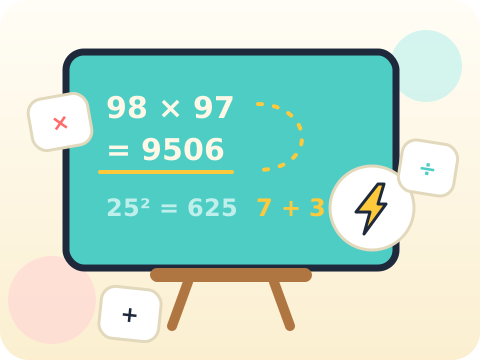
Vedic Maths
Pattern-based mental calculation techniques taught with understanding, practice and friendly challenges.
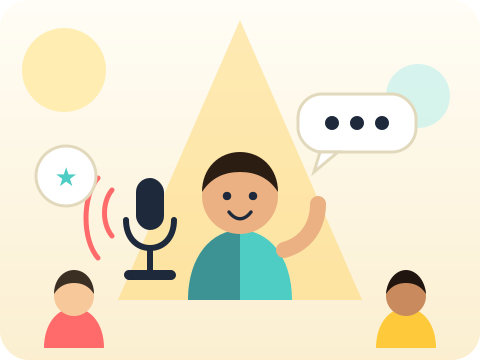
Public Speaking
A five-stage confidence ladder from show-and-tell to structured stories, conversation and presentations.

Creative & Digital Skills
Art, storytelling, logical thinking and safe digital creation for curious young learners.
Reading begins with sounds, not spellings.
Our six-level Phonics pathway starts at age four with pure letter sounds, moves into blending and segmenting, and finishes with children reading a levelled storybook aloud and retelling it in their own words.
- 44 English sounds taught in reading-useful order
- Blending and spelling practised every session
- Batches capped at eight so every child reads aloud
- A short weekly practice note for home
Find the right learning program for your child's age
These bands are a guide to how learning is grouped. Exact eligibility depends on the individual program — tell us your child's age and we will confirm what they can join.
Ages 3–5
Foundation & curiosity
Play-led sessions that build listening, motor skills, curiosity and comfort in a group.
Ages 6–8
Exploration & skill building
Children try several activities and start practising one or two of them consistently.
Ages 9–12
Confidence & problem solving
Longer challenges, small projects, presenting work and more independent thinking.
Ages 13–16
Future skills & awareness
Coding, AI literacy, public speaking and the skills that carry into higher classes.
How to join a class at Brolly Juniors
Four steps from first enquiry to first class.
Choose a program
Tell us your child’s age and interests, or browse the programs and shortlist one or two.
Book a free trial
Pick a convenient slot. The trial is a real class, not a sales call.
Meet the educator
Your child tries an activity and you get an honest view of fit and starting level.
Start learning
Confirm a batch, a mode and a schedule, and begin regular classes.
Flexible learning options for busy families
Not every mode runs for every program. Ask us which formats are currently available for the program you want.
Classroom classes
In-person sessions at the Nizampet centre, with materials, peers and hands-on activities.
Online classes
Live sessions from home, useful when travel time across Hyderabad is the real constraint.
Weekend batches
Saturday slots designed around school schedules and weekday homework.
Weekday batches
After-school timings for regular weekly practice through the term.
School programs
Activity and skill modules delivered on school premises as periods, clubs or workshops.
Community programs
Weekend and holiday sessions run inside apartments and residential societies.
What makes an activity class different from a lesson
Both have their place. The difference is in how much a child does versus how much a child watches.
How Brolly Juniors classes run
- Learning through activities and challenges
- Practical exercises in every session
- Interactive, discussion-led sessions
- Grouping by age and current level
- A defined skill as the goal of each program
- Confidence built through presenting and performing
- Continuous practice with take-home tasks
- Regular communication with parents
What a memorisation-led format looks like
- Heavy reliance on repetition and recall
- Limited interaction during the session
- One pace and one approach for the whole group
- Fewer opportunities to apply what was taught
This describes a teaching style, not any particular institution.
What a typical class looks like
Structure varies by program and age group, but most sessions follow this rhythm.
Welcome
Settling in, a quick check-in and a recap of the last session.
Warm-up activity
A short game or puzzle to get children thinking and talking.
Concept introduction
The new idea, technique or move for the day, explained simply.
Hands-on practice
Children try it themselves while the educator moves around the room.
Challenge or game
The concept applied under a bit of friendly pressure.
Feedback
What went well and what to work on, said in a way children can act on.
Take-home activity
A short practice task, so the skill does not wait a week to be used.
Come and see a class
The quickest way to judge fit is to watch your child in one session. Trial slots are free and there is no obligation to enrol.
Each class moves forward—not back to lesson one.
AI and Python are separate programs, with a distinct annual curriculum for every class from 6 to 10.
Explore
Safe foundations, clear prompts and first coding projects.
Build
Research, creative media, stronger logic and reusable code.
Connect
Data, multimodal creation, structured programs and games.
Apply
Evaluation, automation concepts, databases and web apps.
Launch
AI products, responsible systems and portfolio capstones.
Projects, challenges and activities
A sample of the kinds of tasks children take on. Which ones your child does depends on their program and level.
Build a simple robot
Robotics · older learners
Problem solving. Children assemble, test and fix a working model.
Create a coding game
Coding · beginner onwards
Logic. A playable game built from scratch, then shared with the group.
Solve a chess challenge
Chess · all levels
Planning. Timed puzzles that reward thinking one move further ahead.
Abacus mental maths challenge
Abacus · level based
Concentration. Calculating without writing anything down.
Storytelling performance
Communication · younger learners
Expression. Telling a story with voice, pace and gesture.
Public speaking challenge
Public speaking · all levels
Confidence. A short prepared talk in front of the batch.
Drawing project
Art · all levels
Observation. A finished piece children take home and can explain.
Logic puzzle challenge
Brain games · all levels
Reasoning. Puzzles that build patience with hard problems.
Python mini-project
Python · Classes 6–10
Structure. A small working program the student demonstrates and explains.
AI research task
AI · Classes 6–10
Verification. Using an AI tool, then checking every claim it made.
Phonics reading aloud
Phonics · ages 4–9
Blending. A levelled book read aloud, then retold in the child’s own words.
Team-based learning activity
All programs · mixed ages
Teamwork. Children split the roles and present as a group.
Stay connected with your child's learning journey
You should never have to guess whether classes are working. Educators share what they observe, where your child is improving and what would help at home.
- Progress updates
- Skill observations
- Attendance
- Activity completion
- Educator feedback
- Improvement areas
- Next-step recommendations
What improved
Specific gains, not general praise.
Attendance
Sessions attended and what each one covered.
Educator notes
Observations from the classroom floor.
What is next
The next level, skill or practice focus.
Small batches. Real projects. Visible progress.

Understand. Practise. Create.
Understand
Clear explanation
Practise
Guided activities
Create
Visible outcomes
What parents say about Brolly Juniors
My daughter went from dreading maths to teaching her grandmother shortcut tricks. The Vedic Maths class genuinely changed her relationship with numbers.
He built a chatbot in week three. He's nine. We had to set screen-time limits on his learning, which is a problem I'm happy to have.
What I love most is that the teachers know my son. They asked about his football match before the class started. That kind of attention is rare.
Why parents choose skill-based activities for their children
Extracurricular classes are not only about keeping children busy after school. Done well, they give a child a second place to succeed.
Builds confidence
Small wins in a low-pressure setting make children more willing to try things at school too.
Encourages creativity
Open-ended tasks let children make choices instead of following one correct path.
Improves concentration
Activities like abacus, chess and cube work train sustained attention.
Develops communication
Presenting, explaining and performing make speaking up feel normal.
Supports problem solving
Children learn to break a problem down rather than freeze in front of it.
Encourages healthy hobbies
A structured interest is a useful alternative to unstructured screen time.
Builds teamwork
Group challenges teach sharing credit, dividing work and listening.
Introduces technology responsibly
Coding and AI turn children from consumers into makers.
Creates after-school structure
A predictable weekly routine helps working parents plan the week.
Kids programs for apartments, societies and workplaces
If a group of children in one community wants the same class, we can bring the class to them.
Apartment communities
Weekend batches run inside your gated community’s activity space.
Residential societies
Multi-activity programs for a mixed age group of resident children.
Corporate family events
Kids activity zones and workshops for employee family days.
Holiday camps
Short summer and vacation camps mixing skills with play.
Kids classes fees and program options
Fees depend on the program, level, duration and mode you choose. We share exact figures on enquiry, so you get the price for your child's actual plan rather than an average.
Monthly program
Rolling month to month
- Regular weekly classes
- Learning materials as applicable
- Educator feedback
- Free trial before you start
Term program
Fixed multi-month term
- Structured level progression
- Practice tasks between classes
- Progress updates through the term
- Free trial before you start
Weekend program
Saturday batches
- Built around school schedules
- Single or multi-activity options
- Classroom or online
- Free trial before you start
Workshop
Short format
- One-day or short-series sessions
- Holiday and summer camps
- School and community formats
- Group rates on request
Kids activities and classes across Hyderabad
Brolly Juniors is based in Nizampet, Hyderabad. Classroom sessions run from the centre and online batches are open to families anywhere in the city.
Neighbourhoods with their own page
- Kids classes in Nizampet
- Kids classes in Kondapur
- Kids classes in Madhapur
- Kids classes in Gachibowli
- Kids classes in Kukatpally
Families also travel in from Nizampet, Kukatpally, Miyapur, Kondapur, Madhapur, Gachibowli, Hitech City, Manikonda, Nallagandla. Call us and we will tell you honestly whether the journey is worth it from where you live.
Brolly Juniors
Metro Pillar No. A689, Dr Atmaram Estates, 3rd Floor, Nizampet X Roads, Nizampet, Hyderabad, Telangana, 500072
Beside Sri Bhramaramba Theatre, near JNTU Metro Station.
Monday – Saturday: 10:00 am – 7:00 pm
Why skill development activities matter for children
School gives children knowledge. Skill-based activities give them practice in using it. A child who has spent a term explaining their coding project to a group finds a class presentation easier. A child who has learned to lose a chess game and play the next one has practised something no worksheet teaches.
The useful combination is academic learning plus practical skills plus creativity plus communication plus physical activity plus social development. No single class covers all six, which is why most families pick one activity for skill and one for enjoyment, and rotate as interests change.
Age matters less than consistency. A child who attends one activity regularly for a year usually gains more than a child who samples four for a month each. Our advice is simple: pick something your child is willing to return to, keep the sessions short enough to stay fun, and give it at least one full term before judging it.
If you are unsure where to start, a trial class is the cheapest way to find out — it costs nothing and tells you more than any brochure.
Helpful resources for parents
Short, practical guides on choosing and getting value from children's activities.
Early reading
At What Age Should a Child Start Phonics?
Most children are ready for phonics between 4 and 5, but age is the weakest of the three readiness signals. Here is what actually matters, and what to do if your child is not there yet.
Numeracy
Is Abacus Good for Kids? An Honest Assessment
What abacus training genuinely does for a child, what it is oversold as, and how to tell whether it is worth two to three years of your family's Saturdays.
Technology
Should My Child Learn AI or Coding First?
AI literacy and programming are different skills that solve different problems. Which one to start with depends on your child's age and temperament — here is how to decide.
AI safety
How to Teach Kids to Use ChatGPT Safely
A practical set of rules for parents: what a child should never type, how to check whether an answer is true, and the one question that separates learning from copying.
Coding
Nine Python Projects for Class 8 Students
Nine Python projects pitched at Class 8 — what each one teaches, what "finished" means, and the extension to try if it turns out to be too easy.
Technology
The CBSE Class 9 AI Curriculum, Explained for Parents
What CBSE's Artificial Intelligence skill subject covers in Class 9, how it is assessed, who should take it, and where students most often struggle.
Numeracy
Abacus vs Vedic Maths: Which One, and When?
They are sold as alternatives and they are not. A side-by-side comparison of age, duration, what each actually trains, and how to choose between them.
Early reading
My Child Can Read But Does Not Understand What They Read
Reading every word and remembering none of it has three different causes, and each needs a different fix. One five-minute test at home tells you which.
Coding
When Should a Child Move From Scratch to Python?
Not a question of age. Two gates decide it: can your child build their own Scratch projects without a tutorial, and can they type? Here is how to check both.
Choosing a class
How to Choose After-School Activities in Hyderabad: A Parent's Checklist
Confused about how to choose after-school activities in Hyderabad? A simple checklist covering interests, age, travel and budget to help you pick the right one.
Early reading
My Child Knows Letter Sounds but Cannot Read Words: What Can I Do?
If your child knows letter sounds but cannot blend them into words, it is more common than you think. Here is why it happens and how Brolly Juniors helps.
Confidence and speaking
How to Help a Shy Child Speak with Confidence, Without Forcing Them
Learn how to build confidence in a shy child without pushing them. Simple daily habits, activities, and when a speaking class actually helps.
What is Brolly Juniors?
Brolly Juniors is a children's learning centre in Hyderabad, Telangana, offering activity-based classes and skill development programs for school-age children. Programs cover AI and Python, coding and robotics, Abacus, Vedic Maths and mental maths, chess and brain games, phonics and early reading, public speaking and communication, drawing, dance, music and drama, plus yoga and life skills. Classes run in classroom and online formats, with weekday and weekend batches, and Brolly Juniors also delivers activity programs for schools and residential communities across Hyderabad. A free trial class is available before enrolling.
What are the best activities for kids in Hyderabad?
The best activity is the one your child will return to each week. The popular categories are coding, robotics and AI for logical thinking, abacus and Vedic Maths for calculation and focus, chess and brain games for strategy, public speaking for confidence, and drawing, dance or music for creativity. Try a free trial in two different categories before committing to a term.
Which kids classes are suitable for beginners?
Most Brolly Juniors programs have a beginner level and assume no prior experience. Coding, chess, abacus, drawing, phonics and public speaking all start from the basics, and children are grouped by age and level rather than placed straight into an ongoing batch. Tell us your child’s age and we will confirm the right starting level.
What age should children start extracurricular activities?
Many children begin structured activities around ages four to six with play-led sessions, then take on skill-based programs such as abacus, phonics or coding as reading and attention span develop. There is no single correct age. What matters more is whether the format suits the child’s current attention span and whether they enjoy going back.
How do I choose a class for my child?
Start with what you want to change — focus, confidence, creativity or screen habits — then shortlist two activities that address it. Check the class format, the batch size and the educator’s experience, attend a free trial, and watch whether your child is engaged rather than merely compliant. Give the chosen class at least one full term before judging results.
Parent FAQs
What ages and classes are Brolly Juniors programs for?
Are AI and Python taught as one combined course?
Do you partner with schools?
How large are centre batches?
Can my child attend a free trial?
What are the best kids activities in Hyderabad?
Are Brolly Juniors classes suitable for beginners?
Do you offer online classes for kids?
Are weekend classes available?
What are the fees for kids classes at Brolly Juniors?
How do I book a trial class?
Where are Brolly Juniors classes available in Hyderabad?
How can parents track their child’s progress?
Can my child join more than one program?
Do you run programs for apartments and residential societies?
Your child's free trial is one message away.
Tell us your child’s class and what they enjoy. We will suggest the closest program fit—no pressure and no upfront payment.